A brand is what people think, feel and expect when they hear a company’s name. Picture 2 companies that sell the same service at a similar price. One is on the buyer’s shortlist before anyone has spoken to sales; the other never hears about the deal. What separates them is rarely the product. It’s what buyers already think of each company.
That head start shows up in the data. In Forrester’s 2025 survey of B2B buyers, 68% already had a front-runner vendor in mind at the very start of their purchase. That front-runner won 80% of the time. Yet only 19% of B2B marketing leaders believe buyers have clear vendor preferences that early (Forrester, 2026).
This guide explains what a brand is and what it isn’t. It then covers the 7 components every brand is built on, the 3 main types of brands and 8 steps to build a strong one. The examples come from brands everyone knows and from identities we’ve designed for clinics, tech companies and consumer products.
Key takeaways
- A brand is what people think, feel and expect when they hear your name. The logo is one signal of it, not the brand itself.
- B2B buyers decide early: 68% have a front-runner vendor at the very start of a purchase, and it wins 80% of the time.
- Every brand is built from 7 components, and most brands are one of 3 types: personal, corporate or product.
- Build in order: audience, positioning, values, identity, then consistency, stories, engagement and measurement.
- Consistency turns assets into memory. Only 15% of 5,046 brand assets that Ipsos tested were truly distinctive.
What is a brand?
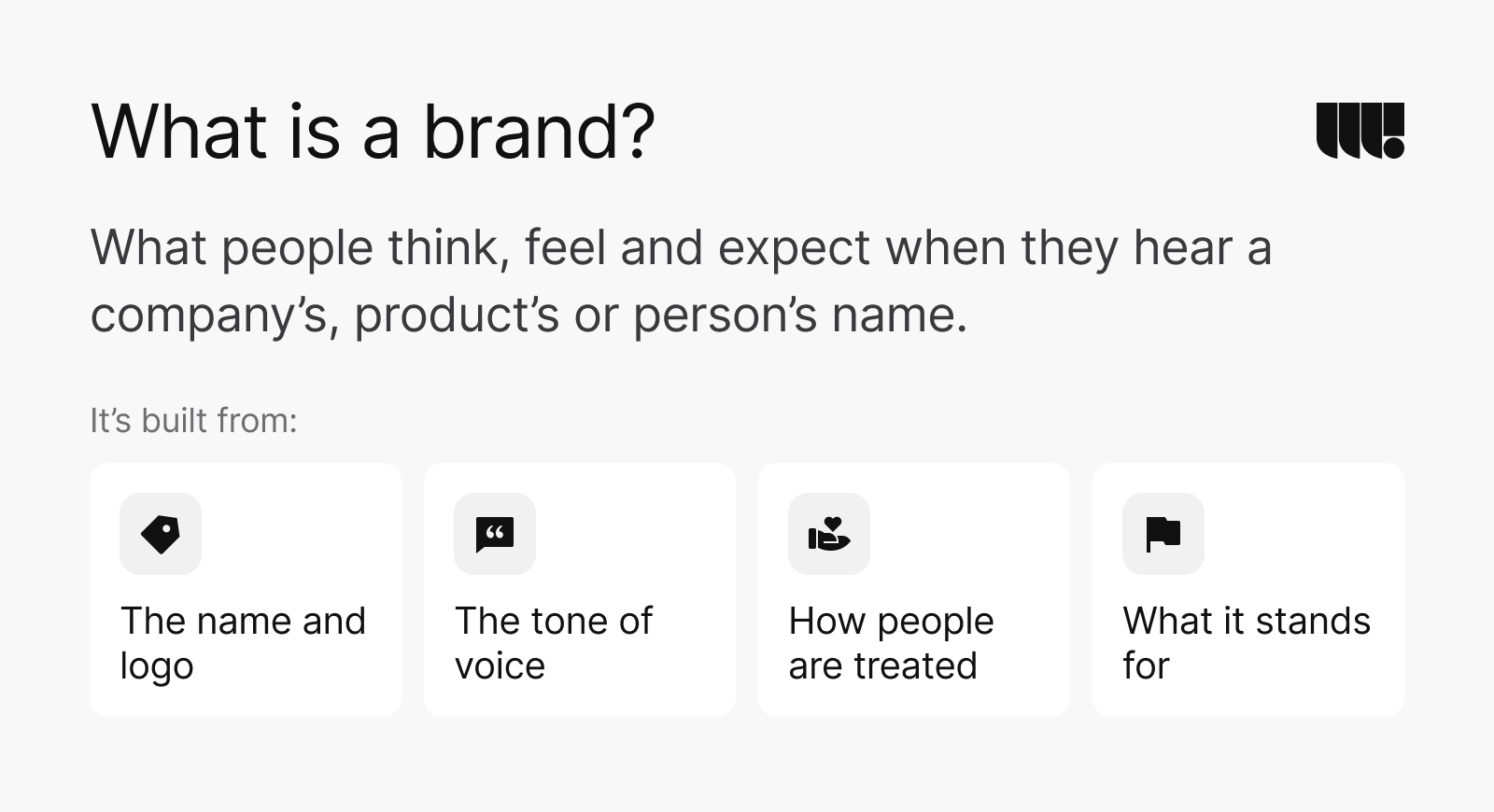
A brand is what people think, feel and expect when they hear a company’s, product’s or person’s name. It’s built from everything they see, hear and experience: the name and logo, the tone of voice, how they’re treated and what the business stands for.
The American Marketing Association puts it more narrowly: “A brand is any distinctive feature like a name, term, design, or symbol that identifies goods or services” (AMA). That describes the marks a business can own. In practice, a mark only identifies you because of everything people have learned to connect with it.
The word is old. In Old English a brand was a burning piece of wood. It later came to mean the mark burned into an animal with a branding iron, so owners could tell their cattle apart (Wikipedia). A brand still does that job: it tells people who stands behind something and what to expect from it.
A company shapes its brand, but it doesn’t own it outright. The brand lives in the minds of customers, employees and everyone else who meets it. Branding is the work of shaping that impression on purpose, one touchpoint at a time.
That’s why 2 companies with similar logos can have very different brands. The logo is a signal. The brand is the memory and the expectation that the signal brings back.
What a brand is not
A brand isn’t a logo, a product, a slogan or an ad campaign. Each of those can strengthen a brand or weaken it, but none of them is the brand on its own.
- It isn’t a logo. The logo is the most visible brand asset, a shortcut people use to recognize you. Change it overnight and the brand stays where it was until people’s experience of you changes too.
- It isn’t a product. Products get updated and replaced. The brand is what carries over between them.
- It isn’t a campaign. A campaign runs for weeks. A brand builds up over years, out of what a company does again and again.
- It isn’t what you say about yourself. People believe evidence: your products, your service, your reviews and your people. A brand that claims what it doesn’t deliver loses trust faster than one that claims nothing.
Brand, branding, brand identity and brand equity
These terms get mixed up in briefs. Here’s how they differ, with the American Marketing Association’s definitions where it has one.
| Term | What it is | Who shapes it |
|---|---|---|
| Brand | What people think, feel and expect when they hear your name | Everyone who meets the company |
| Branding | The work of shaping that impression on purpose | The company |
| Brand identity | The name, logo, colours, typography and design elements that represent the brand (AMA) | The company |
| Logo | One mark inside the identity | The company |
| Brand equity | The value a brand holds in people’s minds: how well it’s recognized, perceived and trusted (AMA) | The market, over years |
Why a brand matters
A strong brand makes the rest of the business easier: buyers shortlist you sooner, trust you more and spend more with you. The research backs that up.
People buy from brands they already know. In a Google and Bain study at US companies, most B2B buyers had a vendor list from day one, and 92% of them chose a vendor from it (Google, 2022). Ipsos sees a similar link in its database of over 12,000 brand assets. Brands with many strong distinctive assets are 31% more likely to be considered and 38% more likely to be used (Ipsos, 2026).
Trust turns into revenue. In PwC’s 2024 survey of 2,515 US consumers, 46% had bought more from companies they trust and 28% had paid a premium. Four in 10 had stopped buying from a company they didn’t trust (PwC, 2024).
Most buyers aren’t buying yet. The Ehrenberg-Bass Institute estimates that up to 95% of business buyers aren’t in the market for a given service at any one time. Companies change suppliers such as their bank only about once every 5 years (Ehrenberg-Bass Institute, 2021). Your brand is what they remember when they are.
Most of what large companies are worth is intangible, and brands are part of it. For the 15 largest US companies, intangible assets such as brands, patents and software make up 91.8% of enterprise value (WIPO, 2026).
The key components of a brand
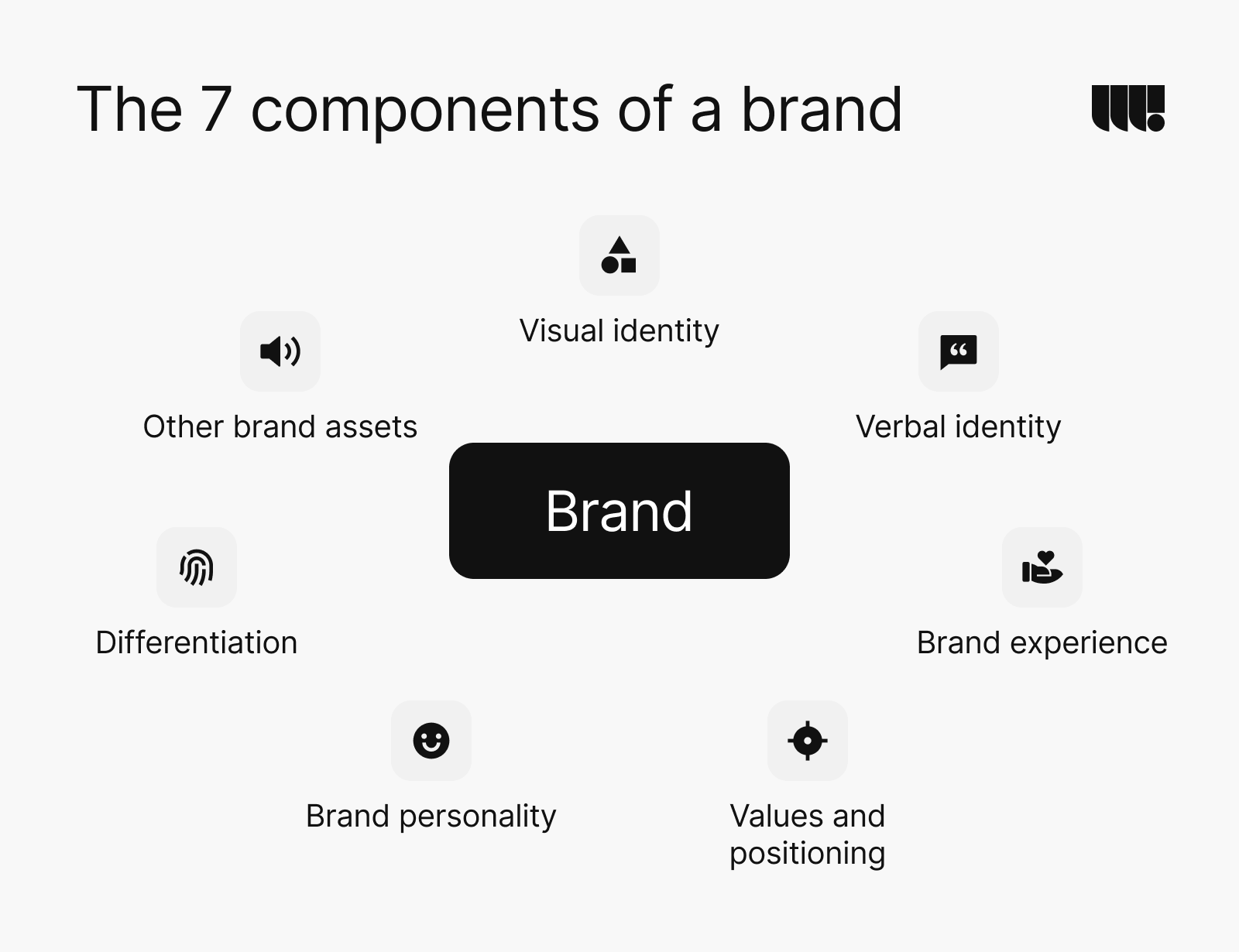
Every brand is built from the same parts. Some are visual, some are verbal and some only show up in how a company behaves. These are the 7 that matter most.
Visual identity
Visual identity is everything people see: the logo, colour palette, typography, icons, imagery and graphic elements. Designed as one system, these parts make a brand recognizable at a glance, often before anyone reads the name.
The strongest visual assets end up working without the name at all. Apple’s apple and Nike’s swoosh appear on products and ads with no name next to them, and people still know whose they are. Shapes do this better than colours. In a 2026 study of 1,162 brand assets, logos and packaging were the strongest type of asset and colours the weakest (International Journal of Advertising, 2026).
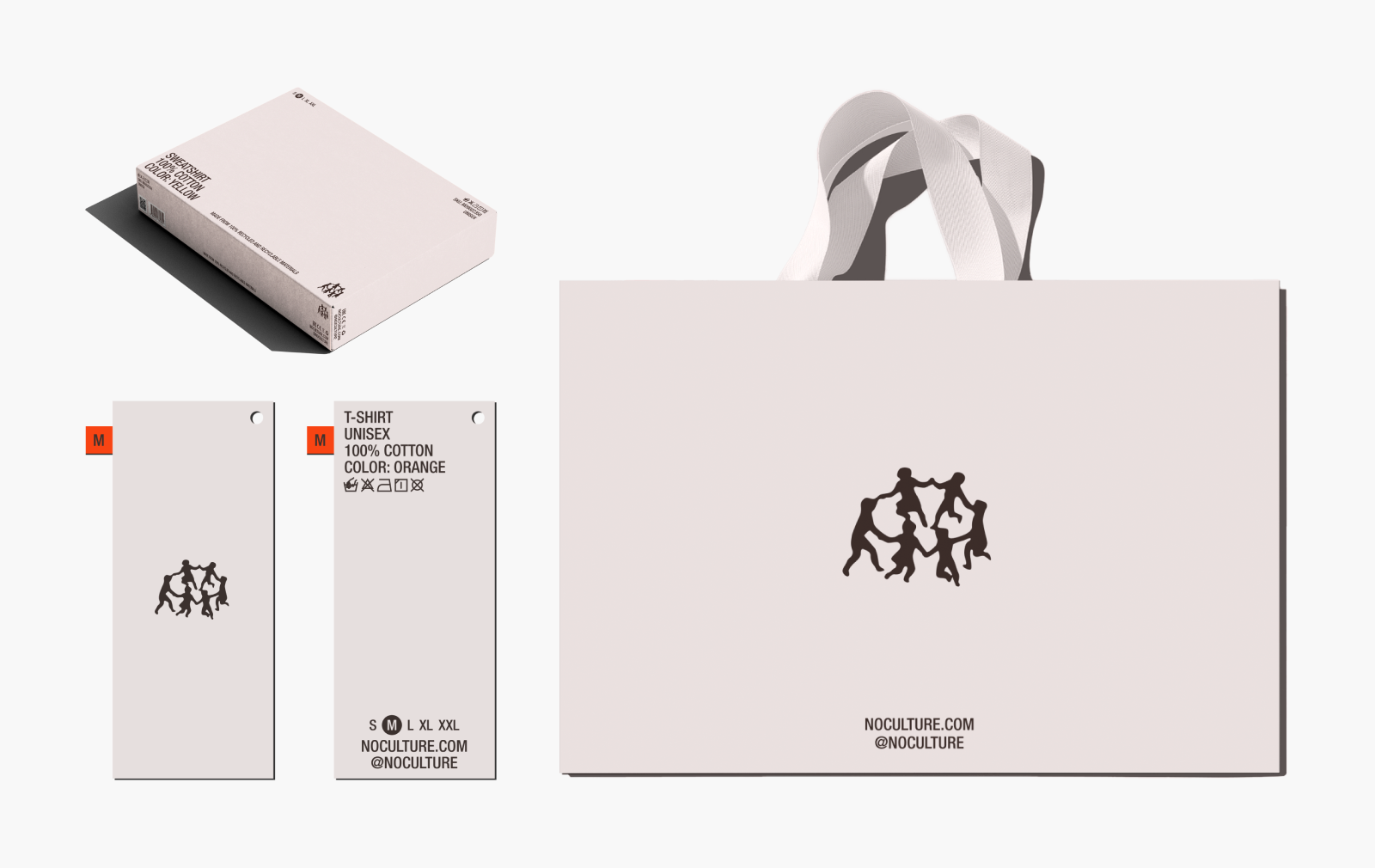
A visual identity also has to work everywhere the brand appears: a phone screen, a delivery box, a trade show banner. That’s why each identity in this guide has colour and monochrome versions of its logo. For No Culture, a clothing brand, the identity carries across tags, boxes and a shopping bag without losing its simple, neutral feel.
Verbal identity
Verbal identity is how a brand sounds: its name, tagline, key messages and tone of voice. It decides whether a company comes across as warm or formal, playful or precise. It also keeps that voice the same in an ad, an onboarding email and an error message.
Mailchimp is a good example. Its content style guide is public, and it sums up its voice in 4 lines: “We are plainspoken”, “We are genuine”, “We are translators” and “Our humor is dry” (Mailchimp). It also separates voice from tone: the voice doesn’t change much from day to day, while the tone changes with the situation.
A practical verbal identity fits on one page: one sentence on what you do, 3 or 4 words for your tone and examples of phrases you use and avoid. For each tone word, say what it doesn’t mean: “friendly, not chatty”.
Brand experience
Brand experience is what it’s like to deal with a company: finding it online, using its website, buying, getting started and asking for help. Each of those moments either confirms what the brand promises or quietly contradicts it.
It’s also where people find out whether the brand keeps its promises. A website that answers their question, a reply within a day and packaging that’s easy to open do more for a brand than a new logo. A slow, confusing checkout can undo a lot of good advertising in one visit.
Values and positioning
Values are what a brand stands for and what it refuses to do. Positioning is the specific place it holds in people’s minds compared with the alternatives. They work together: values keep the positioning honest.
Volvo is the classic example. Its engineer Nils Bohlin perfected the three-point seatbelt in 1959, and Volvo gave the patent to the world for free (Volvo Group). That one decision still backs up the safety promise Volvo is known for: positioning with proof behind it.
Your positioning can fit in one sentence: for [audience], [brand] is the [category] that [main benefit], because [proof]. If the proof is hard to fill in, the positioning isn’t ready.
Brand personality
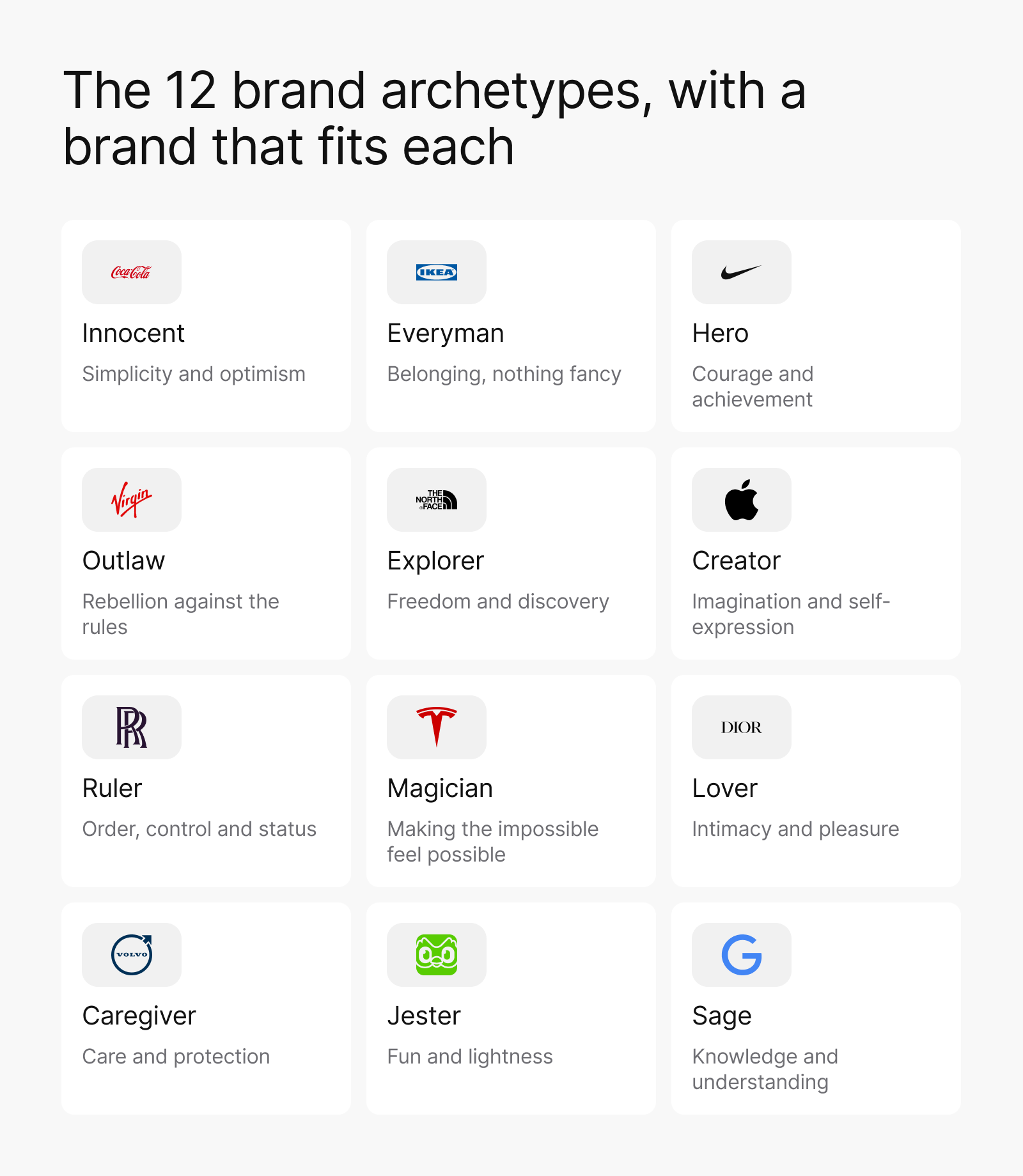
Brand personality describes a brand as if it were a person: confident or modest, playful or serious, rebellious or reassuring. Many teams pick one of the 12 brand archetypes, a framework Margaret Mark and Carol Pearson popularized in their 2001 book The Hero and the Outlaw.
| Archetype | What it offers | Often cited example |
|---|---|---|
| Innocent | Simplicity and optimism | Coca-Cola |
| Everyman | Belonging, nothing fancy | IKEA |
| Hero | Courage and achievement | Nike |
| Outlaw | Rebellion against the rules | Virgin |
| Explorer | Freedom and discovery | The North Face |
| Creator | Imagination and self-expression | Apple |
| Ruler | Order, control and status | Rolls-Royce |
| Magician | Making the impossible feel possible | Tesla |
| Lover | Intimacy and pleasure | Dior |
| Caregiver | Care and protection | Volvo |
| Jester | Fun and lightness | Duolingo |
| Sage | Knowledge and understanding |
The archetype is a shortcut, not a costume. Each archetype suggests a tone, a visual style and the kind of stories a brand tells. That keeps decisions consistent when many people work on the brand.
Differentiation
Differentiation is the reason to choose you over a competitor that looks similar. It can be a feature, a price model, a level of service, a specialization or a point of view. What matters is that buyers care about it and competitors can’t easily copy it.
In B2B, the strongest differentiation is often a narrow focus: a firm that only serves one industry, or software built for one kind of team. A focus like that is easy to remember and hard for a generalist to claim.
Procore is a clear case. It has served construction for over 20 years, and it calls its technology “purpose-built by and for the people behind every build” (Procore).
Other brand assets
Beyond logos and colours, brands can own shapes, sounds and characters. In 1915, Coca-Cola’s bottlers asked glass companies for a bottle so distinct that people would know it by feel in the dark (The Coca-Cola Company). Michelin unveiled its Michelin Man at the first Paris Motor Show in 1898 (Michelin). Mastercard pairs a short sound with an animation at checkout, in stores and online (Mastercard, 2023).
These assets work for the same reason a logo does. They’re used the same way for years, until people connect them with the brand without thinking.
The main types of brands
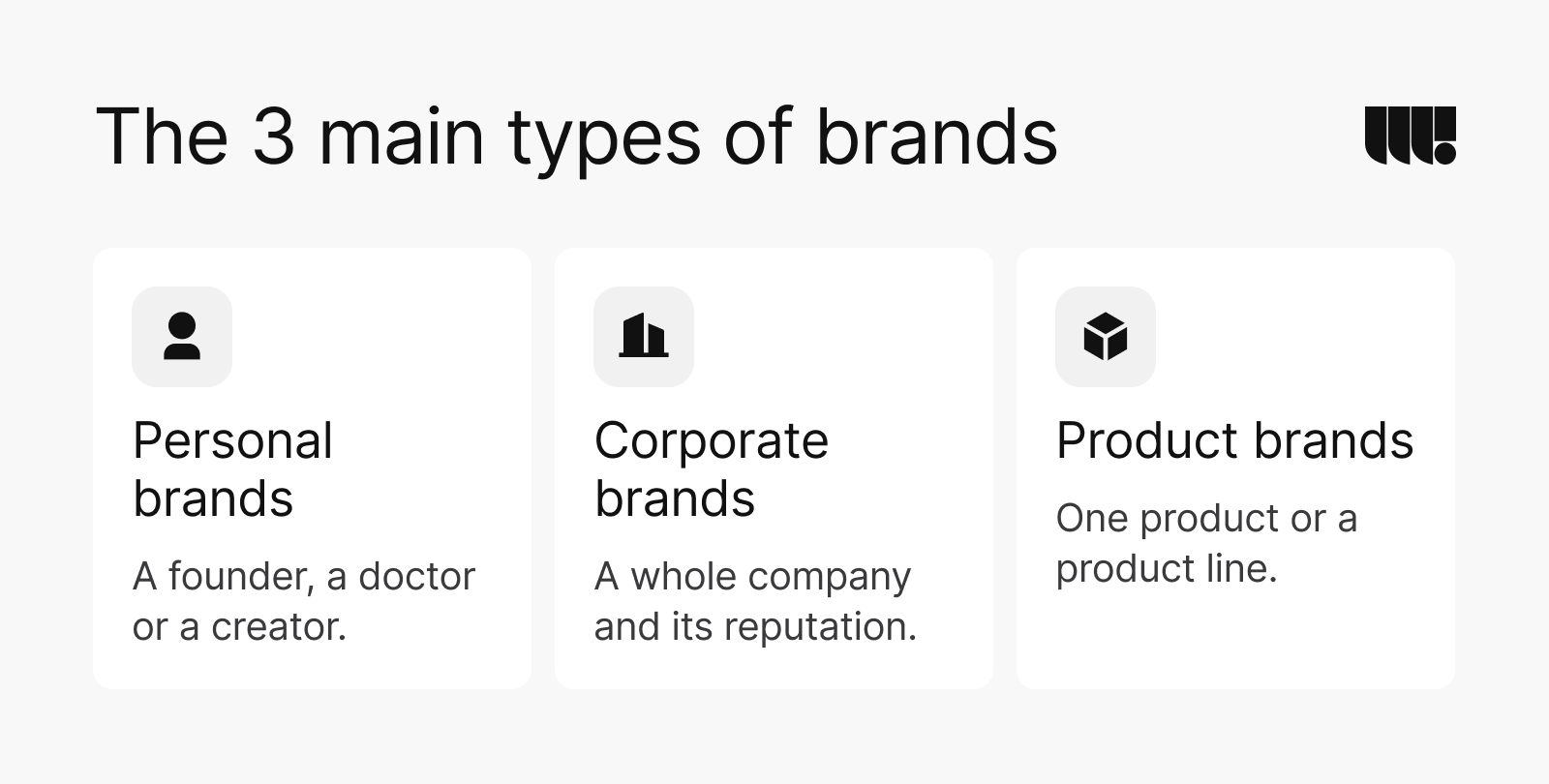
Most brands fall into one of 3 types: personal, corporate and product brands. Large companies often run all 3 at once, and the end of this section covers how they fit together.
Personal brands
A personal brand belongs to a person: a founder, a doctor, a consultant, a creator. It rests on that person’s expertise, reputation and visibility. In professional services, the personal brand often is the company’s brand, because clients choose the person.
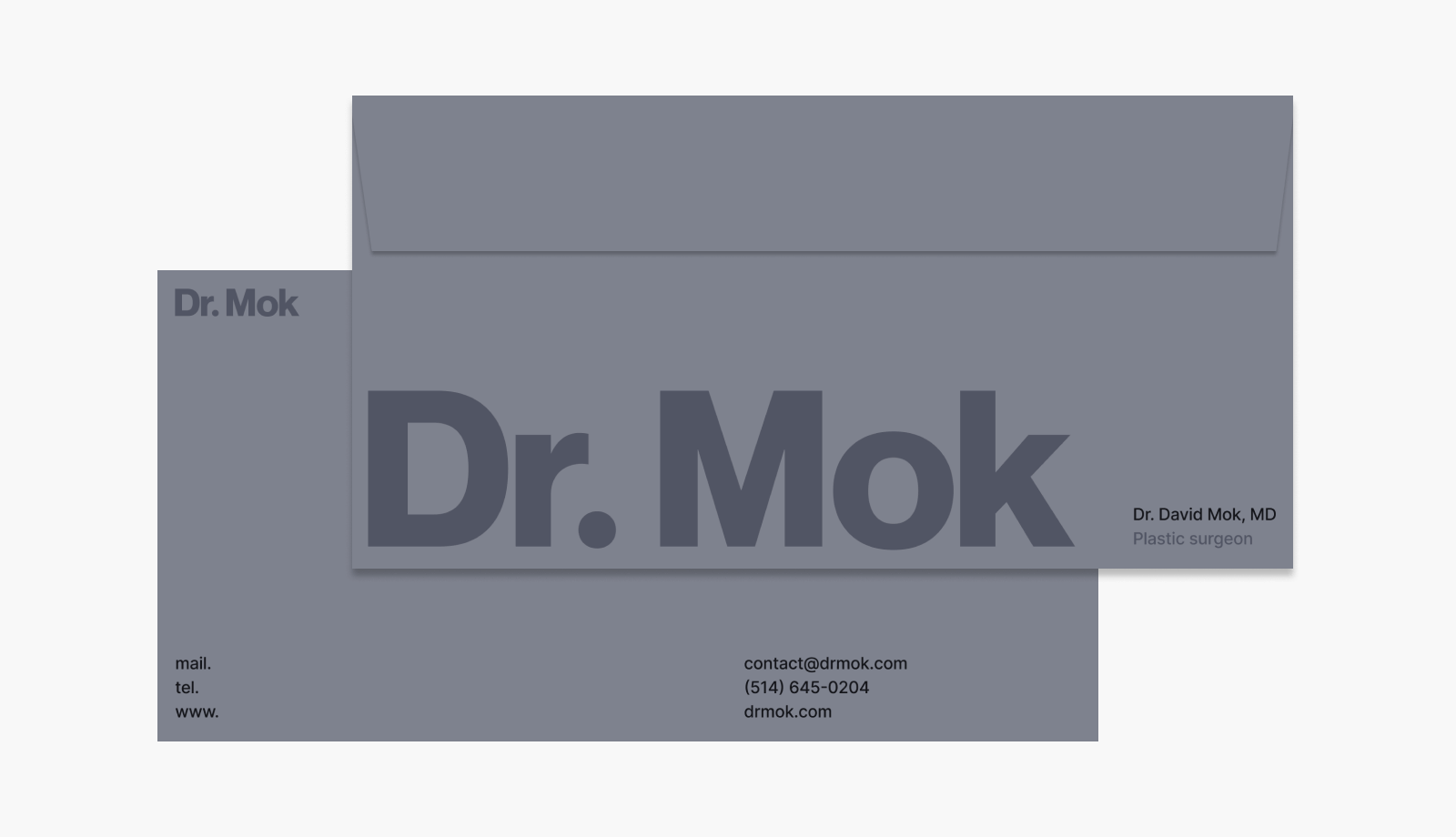
Dr. David Mok’s plastic surgery clinic is a personal brand: it carries the surgeon’s name. We designed its identity around a colour palette that reflects reliability and expertise, with a logotype built from sharp, straight lines. The new style then carried across the clinic’s website and stationery.
Corporate brands
A corporate brand represents a whole company: its mission, culture and reputation, across everything it sells. It speaks to customers, but also to investors, partners and future employees. That makes it the brand most B2B companies need first.
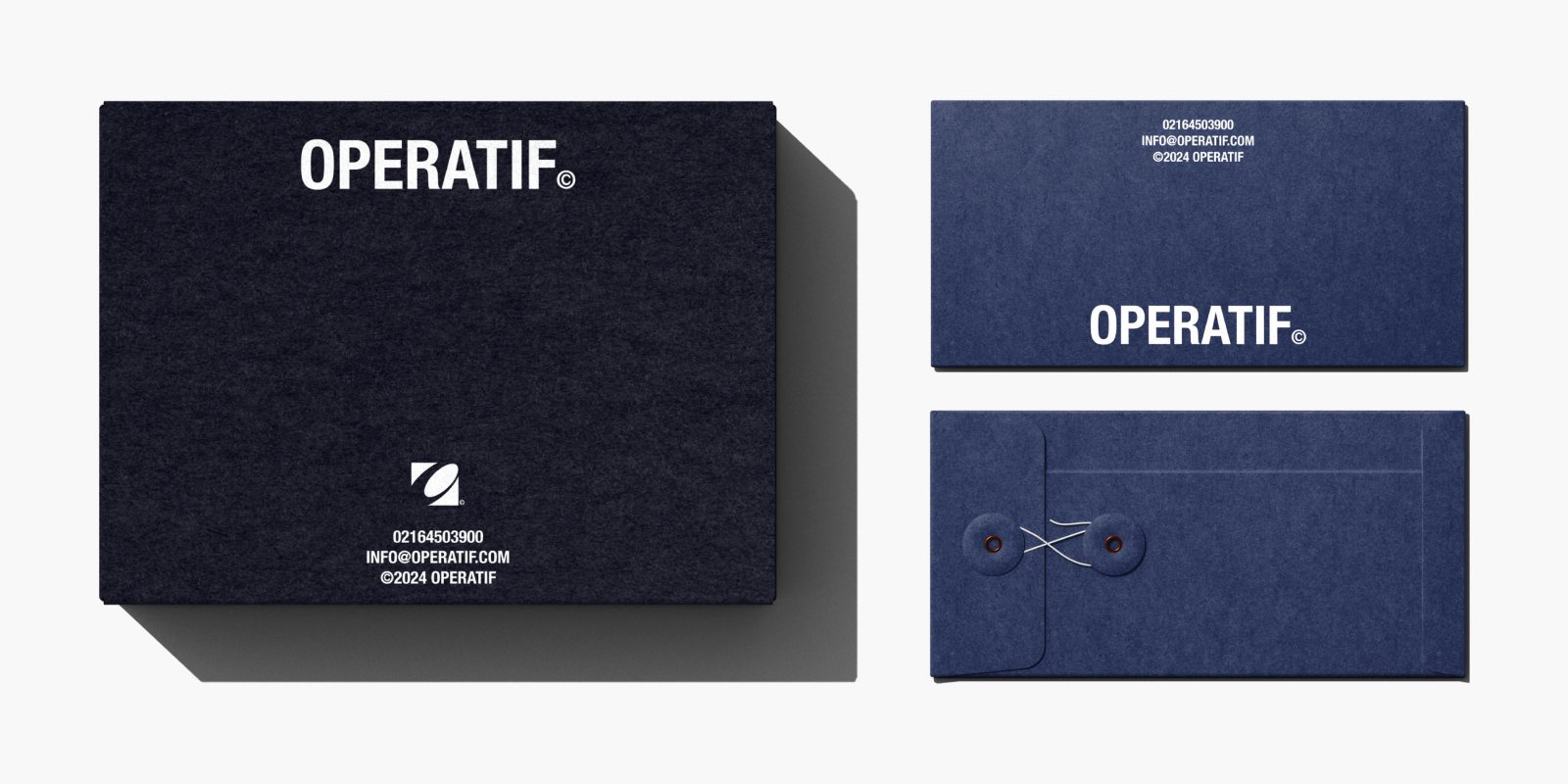
Operatif, an IT company that installs servers and provides infrastructure for businesses, needed an identity that emphasizes its expertise and reliability. We chose a dark blue that conveys confidence and professionalism and designed the identity to work on screens and in print.
Product brands
A product brand gives a single product or product line its own name and identity, often separate from the company behind it. Lexus is Toyota’s luxury brand, with its own dealerships and its own personality. Product brands let one company speak to different audiences without stretching one brand to cover them all.
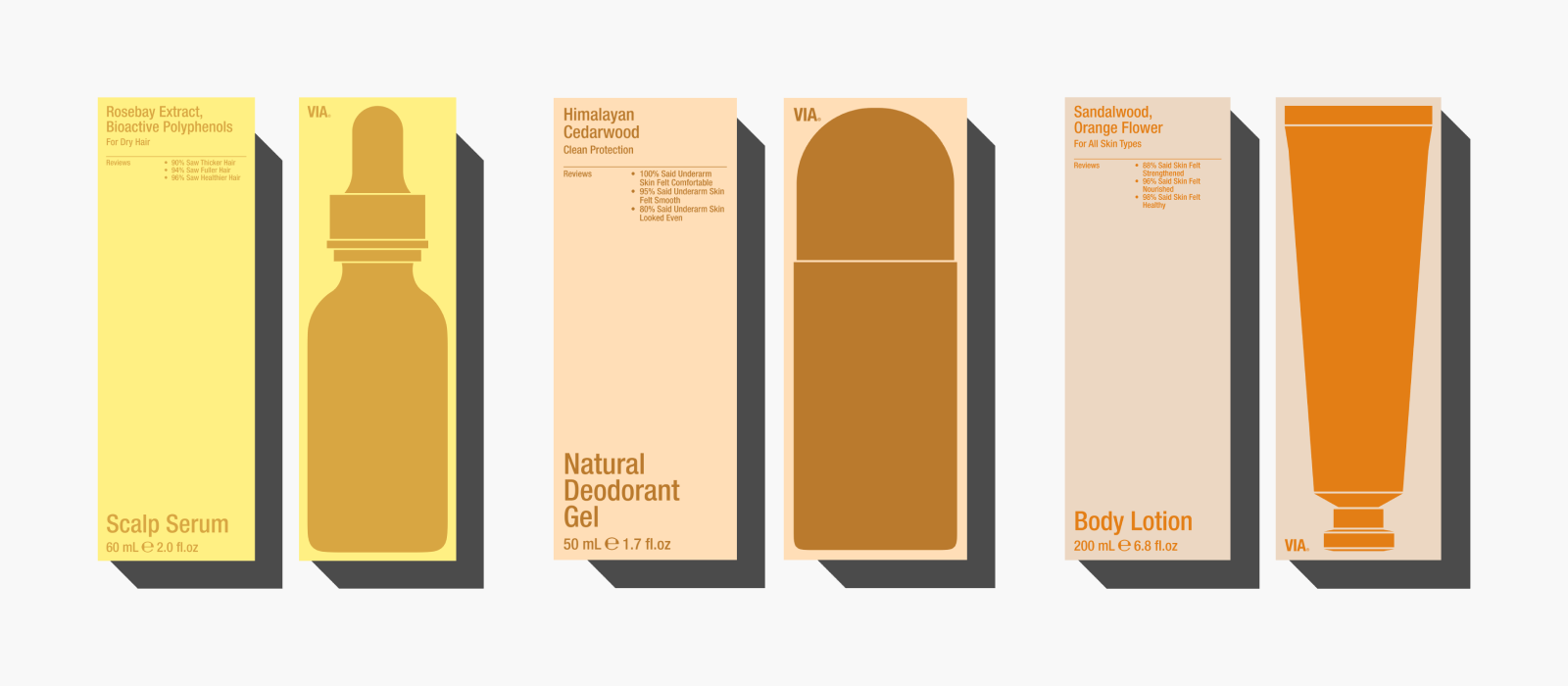
VIA, a skincare brand, shows where many product brands start: the company and its products share one name. We designed the logo, the packaging and a website concept, with soft pastel tones that convey calm and care and a clean condensed typeface for contrast. The packaging carries one identity across the whole product line.
How the types fit together
When a company owns several brands, it has to decide how they relate. That decision is called brand architecture. A branded house puts everything under one master brand, as Google does with Google Maps, Google Drive and Google Docs. A house of brands lets each product stand alone, as Unilever does with Dove and Axe. Many companies sit in between, with endorsed brands such as Courtyard by Marriott.
For a startup, the answer is almost always one brand. A second brand is worth its cost only when it serves an audience that the first brand would confuse.
How to build a strong brand in 8 steps
Strong brands get built in a fairly predictable order: understand who you’re for, decide what you stand for, then express it and repeat it everywhere. Here are the 8 steps, each with how to do it in practice.
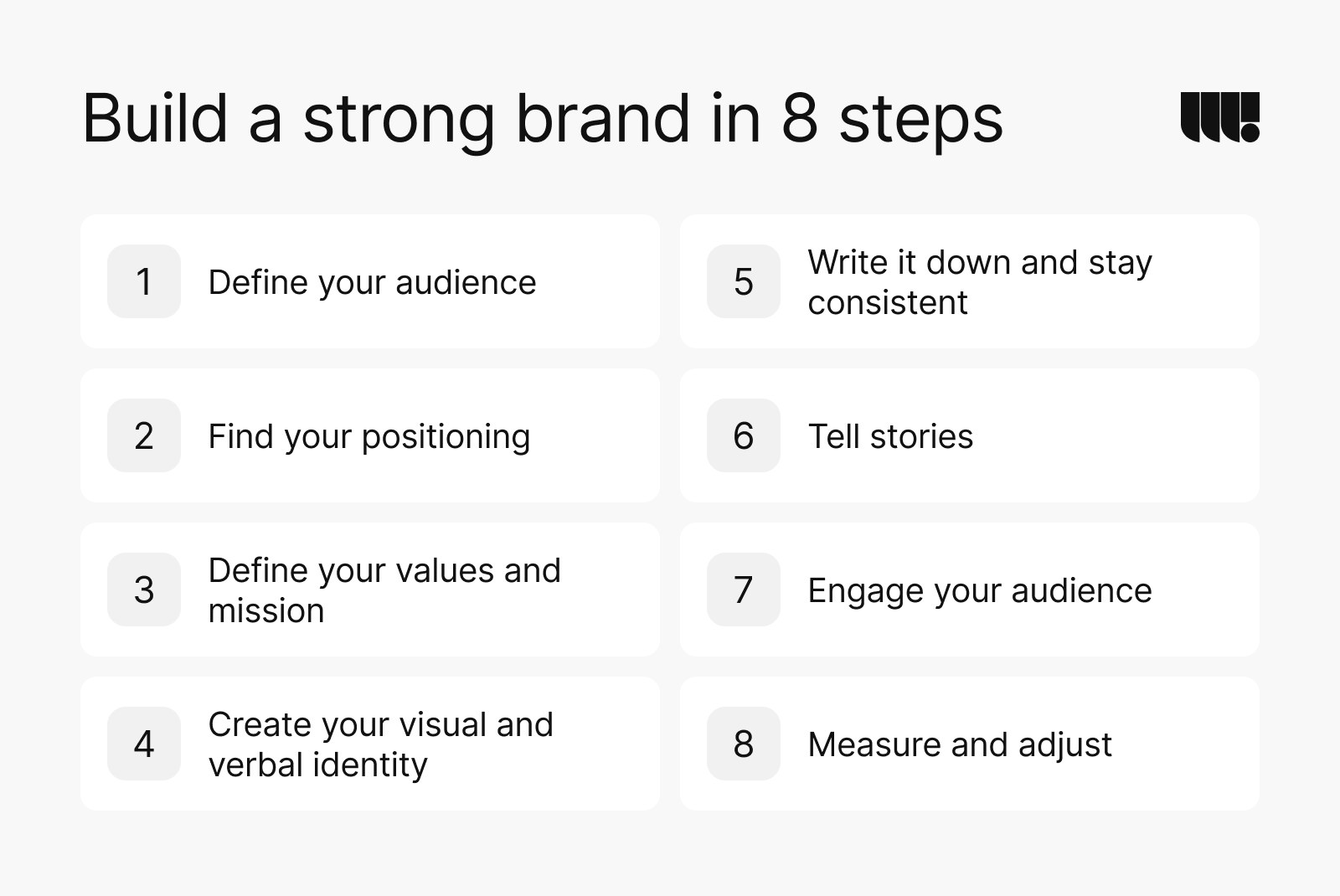
1. Define your audience
A brand can’t appeal to everyone. Start with the people you most want to win: what they need, what they compare you with and what makes them trust a company like yours.
How: talk to 5 to 10 customers or prospects, read your sales and support conversations and write what you learn as 2 or 3 user personas. On our branding projects, audience and market research come first for this reason.
2. Find your positioning
Positioning is the one idea you want to own in your audience’s mind. It has to be true, it has to matter to buyers and it should be hard for a competitor to claim as well.
How: list your 3 to 5 closest competitors and what each one promises, then look for the gap that matches what you do best. Write it as a positioning statement and test it on a few customers before you design anything.
3. Define your values and mission
Values tell your team how to decide when nobody is watching, and a mission says why the company exists. Both show up in what customers experience. They belong to the brand, not only to an HR deck.
IKEA’s vision is “to create a better everyday life for the many people”. Its business idea spells out how: well-designed, functional home furnishing products “at prices so low that as many people as possible will be able to afford them” (IKEA). The flat packs, the self-service warehouses and the low prices all follow from those 2 lines.
How: pick 3 to 5 values and write, for each one, something you do because of it and something you refuse to do. If a value doesn’t change any decision, drop it.
4. Create your visual and verbal identity
The identity turns your positioning and values into something people can see and hear. Brief your designer with your audience, your positioning statement and your values, not with logos you like.
How: agree on 3 or 4 brand attributes first (for example, “precise, calm, approachable”) and judge every design option against them. Design the logo in colour, black and white and inverted versions, define the clear space around it and test it at small sizes, such as a browser tab icon. Write the one-page verbal identity at the same time, and test the name, tagline and tone alongside the design.
5. Write it down and stay consistent
Consistency turns brand assets into memory. A brand that looks and sounds different on every channel never builds recognition, because people never see the same thing twice. Few assets ever get that far: of 5,046 brand assets that Ipsos tested for the design agency JKR, only 15% were truly distinctive (JKR, 2023).
How: write a brand guide that covers logo versions and clear space, colours, typography, icons, tone of voice and examples of each in use. Give your team ready-made templates and name one person who approves anything new.
6. Tell stories
People remember stories better than claims. Why you started, the problem you set out to fix and what changed for your customers all make a brand concrete.
The strongest story is usually a customer’s: who they are, the problem in their words, what you changed and what happened next. Buyers can picture themselves in it, which no claim can do.
How: collect 3 kinds of stories (why you started, what you do differently and what changed for a customer). Reuse them on your website, in sales decks and on social media.
7. Engage your audience
Every reply, comment and support ticket is a brand moment. Answering quickly and in your brand’s voice shows people that the values on your website are real.
How: set a response time you can keep, write reply templates in your tone of voice and choose the channels you’ll actually maintain. A few channels done well beat many done badly.
8. Measure and adjust
A brand is never finished. Markets, products and audiences change, and the brand has to keep up without losing what people already recognize.
How: track a few signals over time. Branded searches show how many people look for your name, and Google Search Console shows them for free. Direct visits, the words customers use in reviews and how often you make a buyer’s shortlist fill in the rest. Review the brand guide once a year.
Branding tools and tips
You don’t need much software to run a brand. A few tools keep it consistent as more people work on it:
- Figma: design files, components and shared brand libraries in one place.
- Adobe Illustrator: logos and other vector artwork that has to scale cleanly.
- Frontify or Brandfolder: online brand portals where the guide, logos and templates live for the whole team.
- Canva: branded templates for people who make social posts and documents without a designer.
- Google Search Console: branded searches over time, one of the simplest measures of brand awareness.
The most useful tip isn’t a tool: decide who owns the brand. Someone has to keep the guide current, approve new materials and say no when something doesn’t fit.
If you’re building a brand or reworking one, our branding services cover the research, the identity, the brand guide and the materials your team uses every day. For early-stage companies, our complete guide to startup branding goes further.